

A new Customs Code on the horizon: will the Customs Service pass the stress test?
Recently, work on the new Customs Code took another step forward: the Cabinet of Ministers of Ukraine approved its draft, which fully harmonizes Ukrainian legislation with EU standards. In light of these developments, the authorities must learn several lessons and adopt the experience of effective coordination and consultative procedures to avoid repeating mistakes that could prove exceedingly costly for stakeholders.
Undoubtedly, in the context of customs reform, 2025 can be called one of the most productive years in recent memory. At the same time, it should be acknowledged that the volume of changes during this period created an unprecedented strain on the entire customs system, which was directly felt by the industry’s key stakeholders. Throughout the year, their interaction revealed both shortcomings and notable successes.
Therefore, in this article, we will examine the main aspects requiring corrective action through the lens of Ukraine’s progress toward implementing the new Customs Code. Meanwhile, you can review the achievements of the coordination platform in the customs sphere throughout 2025 in the monitoring report by the Institute of Analytics and Advocacy via the link.
A fragmented planning system that fails to account for European realities
An analysis of the strategic planning system revealed that it is overloaded: at least 29 strategies, concepts, and plans currently in force relate to the customs sector. The National Revenue Strategy through 2030, which also covers the customs domain, was meant to serve as a general framework; in reality, however, most other documents exist in parallel, detached from it.
Only 40% of strategic documents include an analysis of the industry’s actual problems, while clear, measurable indicators are the exception rather than the rule. For instance, in the Medium-Term Plan for Customs Authorities Reform, only 19% of measures can be considered measurable—the rest are so vague that assessing progress is impossible. As a result, we face fragmentation, duplication of tasks, and diluted priorities, making the sector’s development vulnerable to external factors.
In this context, the implementation of the new Customs Code becomes particularly significant. It must be managed and phased, anticipating clearly defined stages for bringing specific provisions into force, as well as establishing transitional arrangements for businesses and customs authorities. Otherwise, there is a risk of losing the operational advantages provided by the previous version of the code, especially if Ukraine has not yet achieved EU membership at the time of transition.
Equally important is synchronization with the European Union as a strategic partner whose integration Ukraine currently pursues. The EU has already launched its own deep overhaul of the customs system, including the creation of the EU Customs Data Hub, the establishment of the EU Customs Authority, the development of IT components, and the introduction of the “trust and check” operator concept. None of Ukraine’s strategic documents, including the National Revenue Strategy, currently reflect these new realities. That is why regular reviews of planning documents and the monitoring of not only domestic implementation, but also external changes in the EU’s customs architecture, are critically important.
Legislative changes: ambitions versus the system’s actual capacities
Law №3926-IX was intended by the Ministry of Finance to be the final set of amendments prior to full harmonization with the EU Customs Code. However, its enactment required additional efforts and generated certain challenges. Above all, to integrate these changes into legislation, the Cabinet of Ministers and the Ministry of Finance worked at an accelerated pace to draft around 30 bylaws—resolutions and orders—more than 20 of which entered into force in 2025. Government bodies physically lacked the time to simultaneously draft new rules, coordinate them, communicate the changes to businesses, and explain the new procedures to customs officers themselves. The expert community was insufficiently involved during the drafting stage, leading to errors in the documents. Ultimately, all of this resulted in inconsistent interpretations of regulations on the ground and a noticeable shortage of practical guidelines.
Case study: Authorizations
Business misunderstanding of the new regulations was clearly reflected in the case of authorizations for customs brokers, customs warehouses, and temporary storage facilities (TSFs). This was one of the requirements introduced by Law №3926-IX.
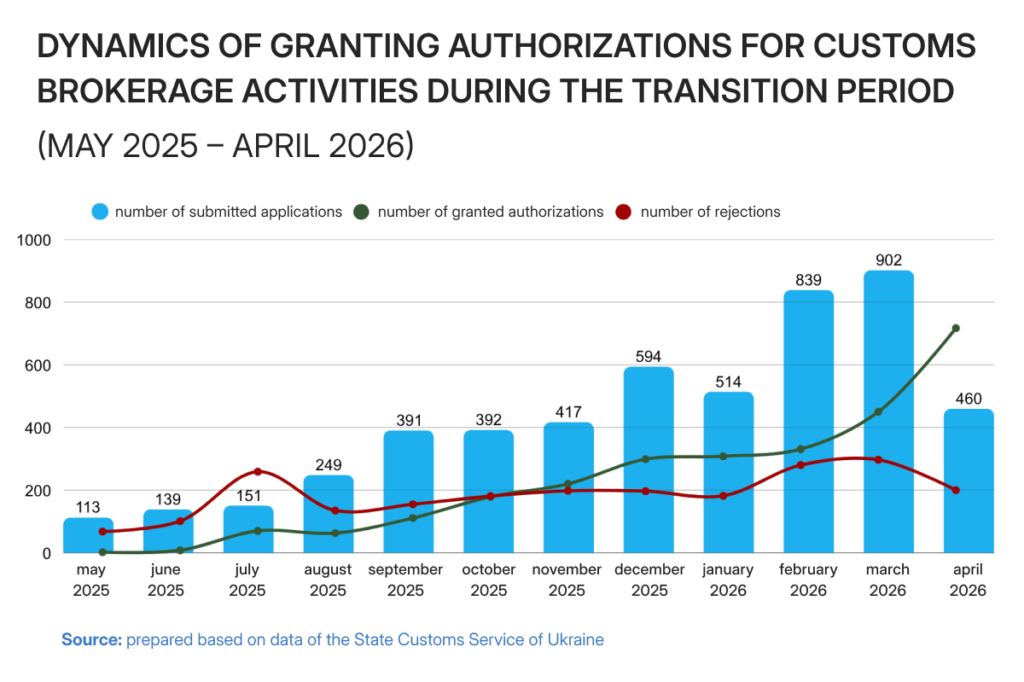
Customs brokers. Due to discrepancies between data specified in the documents and the Unified State Register (USR), as well as missing or incorrectly filled-in information, these entities received more rejections than authorizations in 2025. Out of nearly 2.5 thousand applications, 53% were rejected. This trend began to reverse in November 2025: the number of accepted applications gradually started to exceed rejections, and as of late April 2026, the total number of authorizations issued to customs brokers reached approximately 2.7 thousand (see Fig.).
Customs warehouses and TSFs. The situation proved even worse for customs warehouses and temporary storage facilities: as of April 20, 2026, 139 customs warehouses and 107 temporary storage facilities had failed to obtain authorization on time. Nearly 10 thousand tons of goods were left “stranded” under customs control—requiring clearance re-processing, relocation to authorized warehouses, or re-secured customs control, all of which entail additional logistics costs, risks of delay, and financial losses.
Consultations: important for the public, but not for the authorities
A clear paradox can be observed: while the Ministry of Finance publishes draft acts, reports on their public discussions almost never contain proposals from businesses or the public. Stakeholders either remain unaware of the opportunity to participate or lack trust in its effectiveness. Conversely, once the acts are adopted, activity surges—stakeholders begin responding to issues that could have been avoided during the drafting stage. This confirms that early stakeholder engagement is not a bureaucratic whim, but a means to enhance regulatory quality.
A relatively successful example was the operation of the working group discussing the draft of the new Customs Code. Through dynamic discussion, representatives from 15 business associations and civil society organizations were able to clarify EU regulations, align them with Ukrainian realities, and reflect them in their own proposals for the draft text.
However, weaknesses in this process also came to light: overly tight deadlines for consultations, questions regarding the legal status of the group’s outputs, and adherence to the full procedure pursuant to Cabinet of Ministers Resolution No. 996. Furthermore, the approach to organizing consultations lacked publicity and transparency—the Ministry of Finance did not publish the working group’s conclusions and comments, and the European Commission’s opinion on the draft of the new Customs Code remains unavailable for public review.
The untapped potential of public councils
Public councils under the State Customs Service and the Ministry of Finance currently remain observers rather than influential participants in coordination. Their decisions mostly boil down to formal acknowledgments (“taking note”), with a lack of systematic feedback from government authorities on how their proposals are addressed. However, the potential of these institutions is far greater.
They should be viewed from a different perspective: as a kind of filter through which all draft regulatory acts of the State Customs Service and the Ministry of Finance must pass before adoption. It is precisely on the basis of public councils that it is expedient to organize initial public discussions, expert debates, and collect positions from business associations and sector experts. This would allow identifying conflict areas, inconsistencies, and potential risks at the drafting stage to prevent future issues. In the context of the new Customs Code, which requires continuous support and adaptation of practices to EU standards, such a model would turn these councils into a permanent institutional platform for coordination among the state, business, and the public.
At the same time, another aspect must not be overlooked—the need to update the composition of the councils. Currently, martial law prohibits this procedure, but other agencies (such as the Ministry of Defense and NABU) have already managed to address this challenge. Therefore, the Cabinet of Ministers should examine this issue, as without motivated experts, no institutional model will operate at full capacity.
To sum up, 2025 demonstrated that the high pace of customs reform is accompanied by a noticeable imbalance between the speed of decision-making and the depth of its consensus. On one hand, significant legislative progress was achieved, and collaboration within the working group on the draft of the new Customs Code demonstrated the effectiveness of a dynamic expert dialogue. On the other hand, the planning system remains oversaturated with disparate documents that fail to account for European realities—making it difficult to set priorities—while the potential of public consultations and public councils has not yet been fully realized.
Ahead lies the new Customs Code, which will serve as the ultimate test of maturity for the coordination model. Its implementation will require not only a high-quality text, but also managed phasing, synchronization with EU customs reform, and continuous support. Some of the identified gaps can be addressed immediately through the implementation of the proposals provided in our report:
- audit of the strategic framework;
- early stakeholder engagement;
- a digital portal for practical guidance;
- transparency and publicity of consultations.
The main lesson learned is that the sustainability of the reform directly depends on the ability to build an orderly strategic planning system, ensure timely engagement of all stakeholders, and develop a shared information and analytical base. This—rather than the number of passed acts—will be the true measure of success when the new Customs Code moves from a draft to daily practice.
This publication was prepared with the support of the European Union. Its contents are the sole responsibility of NGO “Institute of Analytics and Advocacy” and NGO “Technologies of Progress” and do not necessarily reflect the position of the European Union.
You may be interested

Ukraine has sufficient funding for 2025, but challenges with the 2026 budget are growing
On 30 January, the RRR4U consortium presented the latest issue of the Monitoring of IMF and EU assistance under the Ukraine Fac...

The UK model of public debt management
Financial, humanitarian, and military support from international partners significantly helps Ukraine to resist the aggression ...

Catalogue of analytics on Ukraine’s recovery
All the analytics of Ukraine’s reconstruction on one site. We have developed a free catalogue of relevant research on Ukr...

Sub-grant competition for non-governmental organisations
The NGO “Institute of Analytics and Advocacy” in collaboration with the NGO “Technology of Progress” an...

Reconstruction of Ukraine: how state, external and public control is carried out
Rebuilding Ukraine during and after the war requires coordinated efforts of organisations involved in the reconstruction proces...

We are looking for a communication manager to join the IAA team
We are looking for a communication manager to join the IAA team🔍 You will have the opportunity to: 📌 implement the communicatio...

IAA Newsletter #1: February
The latest news about Ukraine’s economy, reconstruction and recovery after the victory, digitalisation, educational oppor...

Research on the practices of reconstruction after destruction: 14 countries
Every new day brings us closer to victory. The Armed Forces of Ukraine are working to liberate our country from the occupiers, ...

Expert consultations for NGOs on adaptation of activities in the conditions of war
The priorities and areas of work of the public sector have changed significantly during the war. Unfortunately, not all CSOs ar...

Amounts, sources and forms of financial support Ukraine expexts to receive from foreign partners in 2023
* – the article refers to the amounts of announced support, both those that require further legislative approval and thos...