

Money for reforms: Ukraine’s economic resilience as a basis for financing reconstruction

In the third year of full-scale war, Ukraine has demonstrated impressive resilience, maintaining macroeconomic stability despite the severe effects of the systemic shock. At the same time, the country faces the need to cover key needs and increase defence spending, while the volume of international assistance is projected to gradually decline over the next year.
It is important to understand that one of the key conditions for attracting funding from external sources is the implementation of reforms aimed at increasing the transparency and efficiency of state institutions and creating favourable conditions for investment, which ultimately contributes to Ukraine’s economic growth and integration into the European community.
In this context, the Institute of Analytics and Advocacy presented a collection of essays in which experts from think tanks, government and the business community share their vision of a number of reforms that will help attract and increase Ukraine’s domestic financial resources, as well as accelerate the country’s progress towards the EU.
Economic challenges in times of war
In 2022, Ukraine’s GDP contracted by 29.1%, the worst performance since independence (although better than the World Bank’s forecast of a 45.1% decline). In 2023, the economy began to recover, and real GDP grew by 5.1%, primarily due to budget spending that stimulated domestic demand and investment, as well as record agricultural yields.
The stabilisation of prices also contributed to the resilience of the economy. The inflation rate, which reached 26.6% in 2022, declined to 5.3% in 2023 due to the NBU’s prudent policy, fixed utility tariffs, and lower food prices. This enabled the NBU to commence a reduction in its key policy rate, which should facilitate further economic growth.
However, export growth is constrained by logistical challenges and the loss of production capacity. In 2022, exports of goods and services decreased by 35%. In 2023, there was a slight improvement in the situation, with exports increasing, but in monetary terms, the decline was 18.7%.
The sharp increase in spending resulted in an increase in public debt. In the summer of 2022, the government reached an agreement with official bilateral and private creditors to suspend debt payments until 2027 (or until the end of the war, should it conclude before that period) and August 2024, respectively. However, Ukraine remains in compliance with its obligations to domestic creditors, international financial institutions and the EU. In 2024, debt service and repayment payments will total approximately $26 billion. The majority of this amount (57%) will be allocated to servicing and repaying domestic government bonds, while the remainder will be directed towards external debt. To illustrate, in the first quarter of 2024 alone, Ukraine made a payment of over $1 billion to the IMF. As of 31 March 2024, the total amount of outstanding IMF loans was $12 billion, with the total including interest and other payments reaching $16.3 billion.
One of the key requirements from international donors to increase confidence in budgeting is the resumption of medium-term budget planning. Leading research fellow at the IER, Oleksandra Betliy, noted in her essay that traditionally, strategic documents were multi-year, while the state budget remained an annual document, undermining fiscal transparency which requires predictability. At the same time, negotiations for international financial support, which is crucial for Ukraine’s economic stability, require a better understanding of the country’s fiscal situation. Therefore, it is not surprising that several structural benchmarks in the current IMF program, as well as measures in the Ukrainian plan, are related to the implementation of medium-term budget planning.
Fundraising forecasts
The support of international partners remains a key prerequisite for the functioning of the economy, as all domestic budget revenues are spent on defending the country. In his essay, Oleksiy Sobolev, Deputy Minister of Economy of Ukraine, emphasised that the development of domestic sources of financing is extremely important for Ukraine, as the projected need for additional financing in 2025, assuming the war ends this year, is about USD 23 billion. The main opportunities for raising funds are the return of Russian assets to Ukraine, attracting foreign investment, expanding exports, creating mechanisms for the return of citizens, and reforming the corporate governance of state-owned companies, which can significantly increase their efficiency and attractiveness to investors.
Reforms in the digitalisation sector also play a significant role in the development of public services and the country’s economy. The introduction of digital solutions and the optimisation of government processes not only improve the efficiency of governance and the quality of service delivery, but also contribute to the growth of state budget revenues and the approximation to European standards.
For example, the introduction of the E-excise system will reduce the level of illegal trade, increase market transparency and promote the development of the legal business sector, thereby improving economic stability and facilitating Ukraine’s integration into the European market. In his essay, Danylo Molchanov, the head of the USAID/UK aid Transparency and Accountability in Public Administration and Services (TAPAS) project, noted that Ukraine is working on implementing its own electronic excise system. This initiative envisages the launch of an electronic tracking system for tobacco and alcohol products. By combining the monitoring of two major excisable goods on one platform, the Ukrainian system promises significant fiscal benefits and improved market regulation.
During a full-scale war, the transport industry is also important, and it is also digitising its processes through the implementation of the eQueue and e-TTN projects. Anatoliy Komirnyi, Deputy Minister of Development of Communities, Territories and Infrastructure of Ukraine for Digital Development, Digital Transformation and Digitalisation, in his essay noted that this is the way to overcome bureaucracy, minimise corruption risks and create conditions for effective business. He emphasised that the implementation of digitalisation initiatives in various transport sub-sectors will facilitate Ukraine’s integration into the EU transport system and markets, improve the business environment and increase the investment attractiveness of the transport sector.
Ukraine now has an understanding of receiving funding under the IMF program and the Ukraine Facility for the coming years, but we need to implement a certain set of reforms.
What to expect from the IMF program?
Since the beginning of the full-scale invasion, financial support from the International Monetary Fund has become one of the key sources of assistance for Ukraine to overcome its economic challenges. In a time of war, the IMF program is not only about money, but also about resilience, predictability, reforms, and signals to other partners.
Receiving funding from the IMF is directly linked to the implementation of structural benchmarks, which include reforms aimed at improving public financial management, transparency and efficiency of the economy.
The current IMF Extended Fund Facility programme provides for the disbursement of $15.6 billion to Ukraine subject to the implementation of the structural benchmarks and, accordingly, to the results of further reviews.
The IMF Board of Directors approved the fourth review of the Extended Fund Facility for Ukraine, which resulted in a fifth tranche of about $2.2 billion. In addition, two more tranches are expected in September and December 2024. Thus, this year, Ukraine will spend ⅔ of the total amount of funding provided under the program.
All subsequent tranches under the program will be much smaller. In March and August 2025, Ukraine is expected to receive tranches totalling $1.8 billion from the IMF, in 2026, Ukraine will receive $2.6 billion, and in the first quarter of 2027, $1.3 billion.
What to expect from the Ukraine Facility?
Ukraine expects significant financial support from the EU under the Ukraine Facility, which will run from 2024 to 2027. The total assistance from the EU in 2024 may reach €16 billion, of which €3 billion will be grants, provided that all indicators of the Ukraine Plan are met in time.
In March-April, the state budget already received two tranches of transitional funding in the amount of €6 billion, and recently Ukraine received another €1.9 billion in unconditional funding. Ukraine will receive the rest of the budget support on a quarterly basis after fulfilling the indicators set out in the Ukraine Plan.
In the second quarter, 9 indicators are to be met, which will allow Ukraine to receive €4.11 billion in September 2024. In the following years, subject to timely and full implementation of all indicators, Ukraine may receive: €12.5 billion in 2025, €7.25 billion in 2026, €1.2 billion in 2027, and €1.32 billion in January 2028 for the implementation of the indicators for the fourth quarter of 2027.
Thus, in the face of uncertainty, it is crucial for Ukraine to find and implement solutions to increase its own domestic sources of financing. First, such resources are critical for financing the army. Secondly, a significant dependence on international assistance makes the country vulnerable and undermines its future sustainability.
It is important for Ukraine to carry out reforms, find and use all possible domestic resources that would allow for more efficient processes and thus free up resources, as well as increase budget revenues.
Ukraine’s plan under the Ukraine Facility and the IMF program are the basis for economic growth and domestic revenue mobilisation. They envisage institutional, economic and sectoral reforms: corporate governance reform, customs and tax reforms, etc. Their implementation is important for real economic recovery and growth. Today every dollar counts to Ukraine.
You may be interested

Research on the practices of reconstruction after destruction: Vietnam
Vietnam was at war for a quarter of the twentieth century. The hostilities between South and North Vietnam destroyed critical i...

Amounts, sources and forms of financial support Ukraine expexts to receive from foreign partners in 2023
* – the article refers to the amounts of announced support, both those that require further legislative approval and thos...

Presentation of the six-monthly review of reconstruction and expert discussion “Reconstruction in Ukraine 2023-2024: conclusions and challenges” (post-release)
On January 25th, a presentation of the six-month review of reconstruction and an expert discussion on “Reconstruction in ...

Tracker of Ukraine’s recovery: March
Every day we read news about how global partners are helping to rebuild Ukraine. Support comes from all over the world: 📌 The E...

Free legal aid to IDPs: meeting with partners
Together with our partners, the Danish Refugee Council / DRC and the Human Rights Group “SICH”, we discussed the cu...

A new Customs Code on the horizon: will the Customs Service pass the stress test?
Recently, work on the new Customs Code took another step forward: the Cabinet of Ministers of Ukraine approved its draft, which...

EU Commission greenlights €4.1 billion for successful implementation of the Ukraine`s Plan Q3 2024 indicators
The European Commission has recommended to the EU Council to allocate almost EUR 4.1 billion for the fulfillment of the indicat...
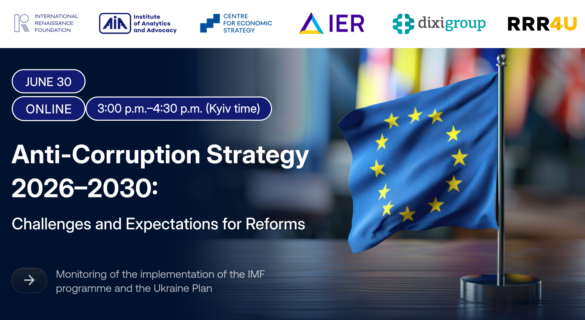
Monitoring of the implementation of the IMF program and the Ukraine Plan
The RRR4U Consortium invites you to the presentation of the June 2026 monitoring reports monitoring Ukraine’s compliance with t...

Theory of big changes: module #2
Students of our author’s course “Theory of Big Change” have already completed the second module💪. During the ...

War and ecology: why does nature fall victim to armed conflict?
Ever since the Ukrainian cities of Donetsk and Luhansk regions were seized by russian subversive groups, the environmental situ...